Rem3Di documentation
Steffen Wedig · Felix Burton · Rokas Elijošius* · Christoph Schran* · Lars L. Schaaf*
Paper: arXiv (2026)
Rem3Di (remedi) repurposes the latent features of a frozen atomistic
foundation model (a machine-learned interatomic potential such as MACE) into a
single fixed-length descriptor of a whole molecule. The descriptor reflects the
molecule's three-dimensional shape and does not depend on the order in which the
atoms are listed. To capture handedness it adds pseudoscalar features, which
are unchanged by rotation but reverse sign under mirror reflection, so the
descriptor distinguishes enantiomers. The result is a feature vector you can use
directly for property prediction, virtual screening, and retrieval.
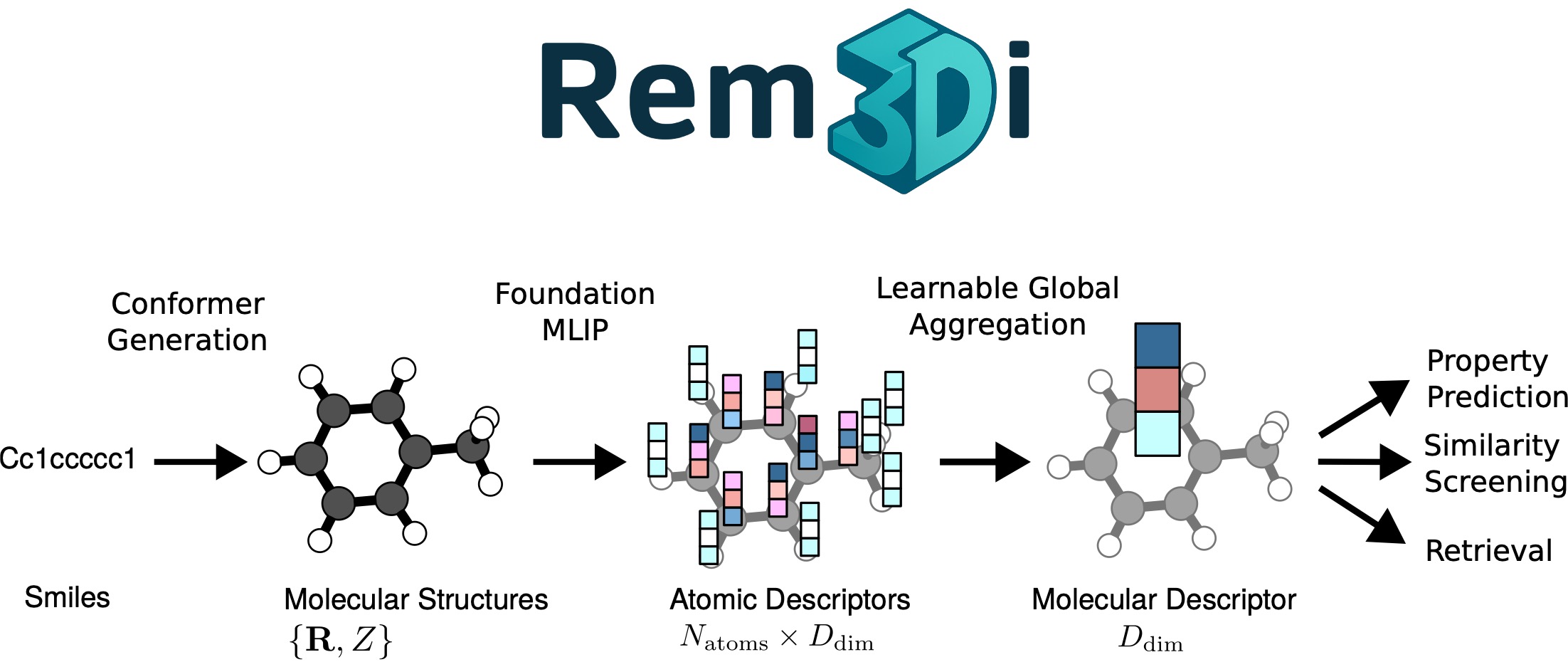
How Rem3Di works
A frozen atomistic foundation model turns a 3D structure into per-atom equivariant features; Rem3Di contracts them into a single fixed-length descriptor.
            SMILES  /  3D structure
                       │
             conformer generation
                       ▼
        ┌─────────────────────────────┐
        │   Frozen foundation MLIP    │
        │         (e.g. MACE)         │
        └──────────────┬──────────────┘
                       │
         per-atom equivariant features
                       ▼
        ┌─────────────────────────────┐
        │       Chiral encoder        │
        │ invariants + pseudoscalars  │
        └──────────────┬──────────────┘
                       │
      global encoder + attention pooling
                       ▼
        ┌─────────────────────────────┐
        │    Rem3Di descriptor  M     │
        │    fixed-length, smooth,    │
        │    permutation-invariant    │
        └──────────────┬──────────────┘
                       │
           ┌───────────┼───────────┐
           ▼           ▼           ▼
       Property   Similarity   Retrieval
      prediction   screening
The foundation model is frozen (no gradients). Chirality is captured by pseudoscalar channels — rotation-invariant but sign-flipping under mirror reflection, so enantiomers get different descriptors. The whole descriptor is pretrained self-supervised by denoising corrupted atom features, so no labels are needed to learn it.
How to read these docs
Pick the page for what you want to do. Each page follows the same layout: what you'll do, prerequisites, steps, outputs, and next steps.
| I want to… | Start here |
|---|---|
| Install the package | Installation |
| Get descriptors from a published model in 5 minutes | Quickstart |
| Embed a dataset / benchmark a model | Evaluate a model |
| Train a predictor on my own labels | Train a downstream model |
| Train a Rem3Di model from scratch | Train from scratch |
| Turn SMILES/structures into a dataset | Prepare a dataset |
| Extract chirality-sensitive pseudoscalars from equivariant features | Pseudoscalars |
| Understand model dirs, datasets, descriptor shapes | Concepts |
The three stages
           Prepare a dataset
        (SMILES / xyz  →  zarr)
                   │
       ┌───────────┼───────────┐
       ▼           ▼           ▼
   Evaluate     Train a   Train from
    a model   downstream    scratch
              (+ labels)  (denoising
                           pretrain)
Most users only need the Evaluate and Train-downstream flows: take a published model, embed your molecules, and fit a head on your labels. Training from scratch is for producing a new Rem3Di descriptor model.
Runnable examples
Short, copy-and-adapt notebooks live in examples/:
01_get_descriptors.ipynb: model dir to descriptors02_train_downstream_head.ipynb: descriptors + labels to a trained head (runs on synthetic data, no GPU)03_build_dataset_from_smiles.ipynb: SMILES to a MoleculeDataset04_pretrain_mini.ipynb: a smoke-sized pretraining run05_pseudoscalars.ipynb: equivariant features to chirality-sensitive pseudoscalars (CPU, no model)